


Constructed wetlands (CWs) are widely recognized nature-based systems (NBS) used internationally as a viable, green technology for treating various types of waste waters, including domestic sewage. They are engineered systems designed to mimic the natural purification processes found in natural wetland ecosystems Constructed wetlands can be used to treat grey wastewater and domestic sewage, as well as waste effluents from (agricultural) industries. Preventing these polluted waters to enter ecosystems prevents ecosystem degradation and increases the overall resilience of an ecosystem. It also safeguards freshwater sources. Increasingly, constructed wetlands are also used to collect and filter stormwater. CWs generally demonstrate high efficiency in removing suspended solids (TSS) and organic matter. CWs also reduce heavy metals such as zinc, copper, chromium, and iron, and are effective in removing pathogens like helminths.
Interestingly, CWs rely on a combination of physical, chemical, and biological mechanisms to improve water quality. The purification process is largely dependent on microorganisms that develop a biofilm on the substrate and plant roots. The role of the vegetation in water purification through extraction is insignificant compared to the action of the bacteria, but the plants provide an indispensable mechanical action. The harvesting of plants does however take away contaminants, because otherwise there no removal of pollutants from the system.
The setup can have various degrees of naturality/technology.
- Free Water Surface (FWS) CWs: These resemble natural swamps, where wastewater flows shallowly over a saturated substrate.
- Subsurface Flow (SSF) CWs: Here, the water flows below the surface, horizontally (HF) or vertically (VF) through the substrate. The Subsurface Horizontal Flow (SSHF) CW is a type that is considered particularly suitable for small and medium-sized communities in developing countries due to its reliability and ease of operation.
- Hybrid and Enhanced CWs: These are combinations of different systems (e.g. VF-HF) or systems with improved technologies such as artificial aeration, intended to intensify removal performance, particularly for nutrients
Feasibility & Local Applicability
Constructed wetlands require careful engineering for a specific contaminant, load and water amount. This determines size and setup. Plants and soils/substrates should be carefully selected based on their filtering capacities as well as on local environmental and climatic conditions. CWs face sometimes trouble to remove nutrients, as for example nitrogen removal is often moderate due to low dissolved oxygen concentrations which discourage the necessary nitrification and denitrification processes.
CWs adapted for tropical use are often relatively compact, requiring approximately 0.8 to 1 square meter per population equivalent (m²/HE), making them competitive where available land is limited, compared to natural pond systems which require 5 to 6 m²/HE in tropical climates.
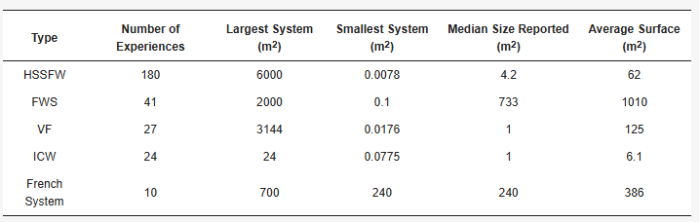
Constructed wetlands present in Latin-America and the Caribbean (Rodirquez-Dominguez et al., 2020)
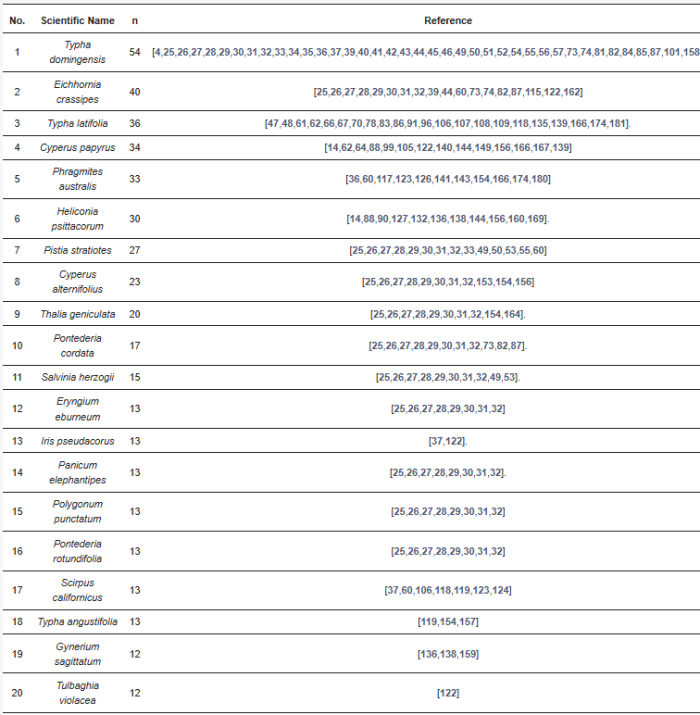
Twenty most commonly used plants in Latin America and Caribbean (Rodirquez-Dominguez et al., 2020)
Plant health can be an issue.
Co-benefits
Constructed wetlands can increase biodiversity in urban and rural areas. Constructed wetlands can be a solution for decentralized wastewater treatment, providing communities with a manageable and cost-effective solution to manage grey/domestic wastewater.
Using local and or esthetic plants can boost biodiversity and look. Experiments with Heliconia Psittacorum (false bird of paradise) and Canna Indica (indian shot).
Equity & Vulnerability Considerations
Using plants as filter system enables new ways of interacting with nature, in using and maintaining these systems.
In general wetlands aids justice around water quality issues. Depending on whether treatment is decentral (at place of pollution) or central (treatment plant) determines distributive justice and perception of the measures.
Costs
Costs will include land acquisition, design and construction and maintenance. However, constructed wetlands, once functional, hardly consume energy compared to conventional systems
Case studies & Examples
- Aruba: Bubaliplas as FWS filter before water enters the sea
- CW solutions seem to be trailing behind compared to other technologies. Noyola et al. (2012), estimated that CW in Latin-American and Caribbean are only used to treat 0.22% of the total wastewater flow in the region. Of the Islands, only the Bahamas and Jamaica have a reported case
Literature
- CARIBSAN. (z.d.). Constructed wetlands.
- World Bank Group. (2004). Constructed wetlands: A promising wastewater treatment system for small localities – Experiences from Latin America.
- Crisman, T. L., & Winters, Z. S. (2023). Caribbean small island developing states must incorporate water quality and quantity in adaptive management of the water-energy-food nexus. Frontiers in Environmental Science, 11, 1212552.
- Garcia-Chevesich, P. A., Morales-Paredes, L., Romero-Mariscal, G., Arenazas-Rodriguez, A., Ticona-Quea, J., Pizarro, R., … Sharp, J. O. (2024). Constructed wetlands to treat polluted waters in Latin America and the Caribbean. International Journal of Water Resources Development, 40(5), 906–914.
- Ozment, S., M. Gonzalez, A. Schumacher, E. Oliver, G. Morales, T. Gartner, M. Silva, Grünwaldt, A., Watson, G. (2021) Nature-Based Solutions in Latin America and The Caribbean: Regional Status and Priorities for Growth. Washington, DC: Inter-American Development Bank and World Resources Institute.
- Pérez, Y., Vargas, E., García-Cortés, D., Hernández, W., Checo, H., & Jáuregui-Haza, U. (2024). Efficiency and effectiveness of systems for the treatment of domestic wastewater based on subsurface flow constructed wetlands in Jarabacoa, Dominican Republic. Water Science and Engineering, 17(2), 118-128.
- Wu, H., Zhang, J., Ngo, H. H., Guo, W., Hu, Z., Liang, S., ... & Liu, H. (2015). A review on the sustainability of constructed wetlands for wastewater treatment: design and operation. Bioresource technology, 175, 594-601.
- Rodriguez-Dominguez, M. A., Konnerup, D., Brix, H., & Arias, C. A. (2020). Constructed wetlands in Latin America and the Caribbean: a review of experiences during the last decade. Water, 12(6), 1744.
- Kollmann, J., Nath, S., Singh, S., Balasubramanian, S., Scheidegger, A., & Contzen, N. (2024). Perceived distributive fairness and public acceptance of a policy mandating on-site wastewater treatment and reuse. Journal of Environmental Psychology, 96, 102292.
- Hurst, E. (2022). Wetlands for water justice: a political ecology of water quality and more-than-human habitability in three constructed wetland projects.