



Managed Aquifer Recharge are interventions that enhance the recharge and injection of aquifers. Replenishing aquifers improves water quality, soil quality, ecosystem health and safeguards water security. MAR is particularly relevant for regions vulnerable to extreme weather events, optimizing water storage during wet seasons and securing water supplies during dry seasons (Solis, 2023). Many different methods and techniques can be deployed to inject water into aquifers. Apart from nature-based methods aimed at improving infiltration capacity of the soils around aquifers, water for aquifer recharge can also be taken from wastewater treatment plans Different water sources can be used, in different configurations:
- Recycled water ((cleaned) wastewater)
- Natural water schemes
- Riverbank filtration schemes
Options to facilitate managed aquifer recharge:
Natural Infiltration Schemes
- Infiltration ponds
- Soakaway/Trench
- Swale
- Infiltration Gallery
- Pervious Paving
- Infiltration Basin
- Ditch and Furrow System
Direct Recharge Techniques
- Open Well/Borehole
- Recharge Shaft
- Injection Bore
In stream infiltration increase
- Channel Modification Techniques
- Check Dams / Gully Plugging
- Recharge Dams
- Streambed Modification
- Catchment Management
- Contour Bunding / Contour Trenching
There are of course also indirect ways to recharge acquifers.
- Afforestation
- Controlled Grazing
Feasibility & Local Applicability
Depending on soil, water availability (and quality).
There are options for specific permeable geologies like volcanic grounds and karsts. For the volcanic islands, a way to channel rainwater into aquifers is through rainwater-fed infiltration galleries. Thes work both ways. These are built underground infiltration galleries to feed aquifers with clean rainwater, but they can also be used to extract water. Water galleries are tunnels, typically around 2 meters high and 2 meters wide, that are excavated into the volcanic rock. They are designed to reach groundwater from the island's aquifers, acting as a continuous source of water to the surface and the other way around. The design takes advantage of the volcanic geology, which features alternating layers of impermeable and permeable rocks, to capture or infiltrate water.
Co-benefits
Depends on the mechanism used. Any nature-based infiltration will have benefits for nature, directly for aquatic nature and birds. Co-benefits can also be found with agriculture.
Equity & Vulnerability Considerations
Notably, irrigation inefficiency can also increase infiltrations. Higher irrigation efficiency rarely reduces irrigation water consumption. Drip irrigation (link to drip irrigation page) is therefore a tradeoff and can reduce overall water availability. This is called the Irrigation efficiency paradox.
Costs
Costs depend on the type of method used and the local hydrological and physical-ecological conditions.
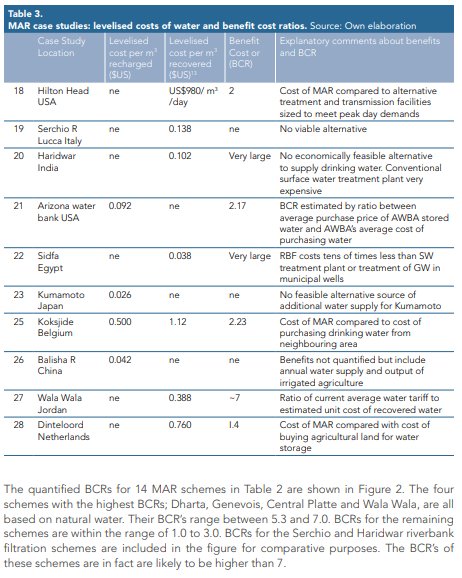
(Zheng et al., 2011)
Case studies & Examples
- Bonaire Wastewater Treatment Plant has ponds to infiltrate recycled wastewater. This water can be used for local agriculture, and agroforestry.
- International case studies can be found in Zheng, Y., Ross, A., Villholth, K. G., & Dillon, P. (2021). Managing aquifer recharge: a showcase for resilience and sustainability. UNESCO Publishing.
Literature
- Zheng, Y., Ross, A., Villholth, K. G., & Dillon, P. (2021). Managing aquifer recharge: a showcase for resilience and sustainability. UNESCO Publishing
- Solís, B. (2023). Groundwater in Latin America and the Caribbean: Policies and Experiences for Managing and Preserving Aquifers. Inter-American Development Bank:
- Stefan, C., Ansems, N. Web-based global inventory of managed aquifer recharge applications. Sustain. Water Resour. Manag. 4, 153–162 (2018).
- European Environment Agency. (z.d.). Adaptation of groundwater management Climate-ADAPT.
- Marazuela, M. Á., García-Gil, A., Santamarta, J. C., Gasco-Cavero, S., Cruz-Pérez, N., & Hofmann, T. (2022). Stormwater management in urban areas using dry gallery infiltration systems. Science of the Total Environment, 823, 153705.
- MANAGED AQUIFER RECHARGE (MAR): PRACTICAL TECHNIQUES FOR THE CARIBBEAN: Promoting Rainwater Harvesting in the Caribbean Region - Phase 2.